Starting the 1957 Triumph Freebird engine rebuild, prepping parts for cad plating

Me: I need the special tool to remove the clutch basket. Can you tell me if I will need any other special tools to do a Triumph preunit engine rebuild?

Motorcycle store dude: No, you really only need that one tool, you really don’t need the cam removal tool as those bushings are usually good.

Listen to advice, but don’t stop listening to your instincts. Turns out I needed a special tool to get the crankshaft pinion gear off to pull the crank and clean the sludge trap, change main bearings, remove the left connecting rod, etc…Once the engine halves were separated, an alarming amount of slop was felt in the cam bushings on the clockcase side. Even more alarming, they were spinning! These are supposed to be a pressed-in friction fit with oiling passages that need to be precisely aligned in the engine case. I ordered the cam bushings and cam gear removal tool hoping for the best.

Once the cams were removed, some of the ugliness can be seen. When you hear the term that someone “smoked the bearing,” this is what it looks like. The area around the cams was smoked too. The spinning bushing would have aligned the oiling hole inte…

Once the cams were removed, some of the ugliness can be seen. When you hear the term that someone “smoked the bearing,” this is what it looks like. The area around the cams was smoked too. The spinning bushing would have aligned the oiling hole intermittently, but obviously not enough. At this point I am thinking the case bores will have to be welded and re-bored or oversize bushings and a bore job are going to be needed.

Before finding the problem with the bushings, I was tempted to just leave the bottom end alone as the guy I bought it from said he had done a complete rebuild when he was in mechanics school, and everything seemed in really good shape as it was bein…

Before finding the problem with the bushings, I was tempted to just leave the bottom end alone as the guy I bought it from said he had done a complete rebuild when he was in mechanics school, and everything seemed in really good shape as it was being broken down. My suspicion is the loose bushing problem was a result of that rebuild. It was a huge relief to discover the looseness was due to the bearing being undersize. The bearing was visibly smaller and scored from being turned on a lathe. No need for repair on the bore.

The turned bush is two tenths of a millimeter smaller!

The turned bush is two tenths of a millimeter smaller!

E3275 cams are supposed to be the long ramp grind that deliver low-end torque.

E3275 cams are supposed to be the long ramp grind that deliver low-end torque.

Made up some aluminum drifts to install the cam bushings.

Made up some aluminum drifts to install the cam bushings.

The tank package rack had some small gaps around the feet that were bothering me. Filling them with steel was not too appealing as the filling was needed in a place that is really tough to sand and smooth down. Instead of steel, brass was brazed in …

The tank package rack had some small gaps around the feet that were bothering me. Filling them with steel was not too appealing as the filling was needed in a place that is really tough to sand and smooth down. Instead of steel, brass was brazed in the gaps.

The nice things about brass brazing is that it flows nicely and needs only a little sanding.

The nice things about brass brazing is that it flows nicely and needs only a little sanding.

Funny how some things that were okay on this piece a few years back when it was made are now needing refinement. The original plan was for this bike to be a bobber with some vintage touches, made to be a solid rider, but nothing close to a show bike…

Funny how some things that were okay on this piece a few years back when it was made are now needing refinement. The original plan was for this bike to be a bobber with some vintage touches, made to be a solid rider, but nothing close to a show bike. I was thinking it would not be too hard to take it up to show level initially, but everything has been revised in some way or another.

Now that the cams are out, the case half can be polished. This was after hours of hand sanding, worked to 3500 grit level.

Now that the cams are out, the case half can be polished. This was after hours of hand sanding, worked to 3500 grit level.

The only way to get that smooth surface without waves in the finish is to block it out by hand.

The only way to get that smooth surface without waves in the finish is to block it out by hand.

After buffing with black compound and then green, it is finally done.

After buffing with black compound and then green, it is finally done.

Rear wheel metal finishing and repair for the 1957 Triumph Freebird Bike.

Getting close to having the metal finishing done on the 1957 Triumph Freebird bike. The majority of parts are at the chrome shop, but some last minute parts still need to be chromed. Because the rim on the rear wheel brake panel was a little banged up and had been plated before (the previous plater probably buffed the steel to the point it is thin and easily bent,) it was replaced with a new one. The replacement was an aftermarket new unit that came painted and appeared to be a decent reproduction at a price of $145.

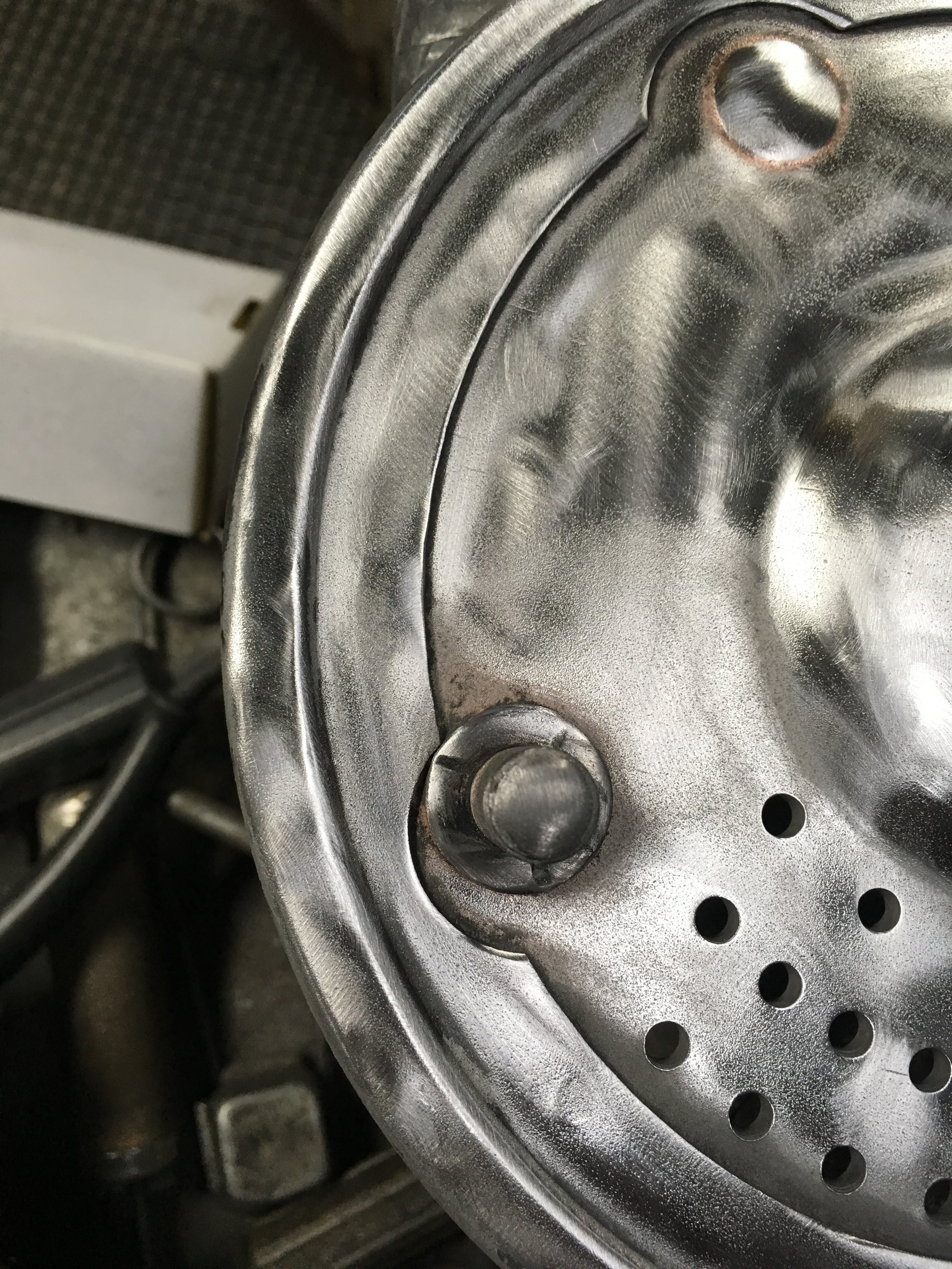
After stripping and drilling it out, it was obvious that the wheel panel rim was poorly aligned. Perhaps if I had noticed this before touching it, I would have sent it back and searched for a nice original one, but at this point I was committed to f…

After stripping and drilling it out, it was obvious that the wheel panel rim was poorly aligned. Perhaps if I had noticed this before touching it, I would have sent it back and searched for a nice original one, but at this point I was committed to figure something out. There is an arm that mostly covers this area to the point it is barely visible on the assembled bike, but it cannot be left like this when so much effort has gone into making the rest of the bike right. When the rim was separated from the plate, none of the surface texture appeared beneath the rim, meaning the texture was from blasting after the parts were assembled, probably to prep for paint.

The spot-welds on the rim were drilled out and the rim rotated to align it better, but there was no way to make it fit correctly around all the posts, so the area around the threaded post seen at the top of the picture was ground a little to make it…

The spot-welds on the rim were drilled out and the rim rotated to align it better, but there was no way to make it fit correctly around all the posts, so the area around the threaded post seen at the top of the picture was ground a little to make it look right. Looking into the drilled holes on the rim, you can see how far off the rim was rotated from the backing plate.

After welding and grinding, it is as if nothing was ever done. The added benefit to separating the ring from the plate was that it was easier to polish out the sand-blast texture with the ring removed, and that after welding, there are no divots fro…

After welding and grinding, it is as if nothing was ever done. The added benefit to separating the ring from the plate was that it was easier to polish out the sand-blast texture with the ring removed, and that after welding, there are no divots from the spot-welds present.

Once again, a brand new Triumph Bonneville rear wheel brake drum fresh out of the box. This will be sent to chrome, but needs polishing.

Once again, a brand new Triumph Bonneville rear wheel brake drum fresh out of the box. This will be sent to chrome, but needs polishing.

The drum was first put on the lathe, and a considerable wobble could be seen on the rear surface while the machined inner side ran straight and true. After it was evened up, the surfaces were worked to get the remainder of the drum smoothed out and …

The drum was first put on the lathe, and a considerable wobble could be seen on the rear surface while the machined inner side ran straight and true. After it was evened up, the surfaces were worked to get the remainder of the drum smoothed out and polished. Around the five o’clock on the drum there is an area of casting inclusions that will need filling.

An alloy head from a 1962 pre unit is being rebuilt for this build, but a frozen exhaust spigot needed removing. After three weeks soaking in kerosene punctuated by half a dozen heatings with a torch, there was zero movement. The answer was to take …

An alloy head from a 1962 pre unit is being rebuilt for this build, but a frozen exhaust spigot needed removing. After three weeks soaking in kerosene punctuated by half a dozen heatings with a torch, there was zero movement. The answer was to take a dremel cutting wheel and score the inner part of the tube. By going just deep enough, small pieces could be removed with a pounding from above without hitting the fragile threads of the head. This was tricky, taking a couple hours, but the only other methods would involve the possibility of thread damage and the need to machine them again…not something you want to do if you don’t have to.

The outer rim and first part of the port took a little damage, but that is easily dressed down. The threads are still crisp and the spigot screws in snuggly. The head was given a complete valve job with new guides pressed in.

The outer rim and first part of the port took a little damage, but that is easily dressed down. The threads are still crisp and the spigot screws in snuggly. The head was given a complete valve job with new guides pressed in.

The gear box adjuster for tensioning the primary chain was missing on this bike, so an NOS set of the needed parts was purchased and polished up in preparation of chrome plating.

The gear box adjuster for tensioning the primary chain was missing on this bike, so an NOS set of the needed parts was purchased and polished up in preparation of chrome plating.

Wire brushing all threads, bead blasting bigger parts, all in preparation for cadmium plating.

Wire brushing all threads, bead blasting bigger parts, all in preparation for cadmium plating.

Just like the gear shift shaft seen in the previous post, there was a lot of rust and pitting on the shifter guide plate. In the search for a new one, a lot of used pre-unit transmission parts was found that had two shift shaft quadrants and a guide…

Just like the gear shift shaft seen in the previous post, there was a lot of rust and pitting on the shifter guide plate. In the search for a new one, a lot of used pre-unit transmission parts was found that had two shift shaft quadrants and a guide plate for the price of what you have to pay for just the repop plate. The original shift shaft quadrant also had some severe pitting where the springs are perched and some smashed splines. The shifter fit over the splines just fine, but appearance-wise it needed changing. The spring perches, shaft surfaces and splines look great on the new shafts and these are evidently from a later model than what was in the original tranny, with a groove for an o-ring cut into it.